Granite Light Walls

|
| Beinecke Rare Book & Manuscript Library, Yale University — interior view during the day. The marble walls do not reflect light. They transmit it. |
Stone is old. Heavy. Opaque. That is the assumption — until you slice it thin enough to glow.
When a veneer of marble or onyx is reduced to the right thickness and placed in front of a light source, the rock ceases to be a barrier and becomes a lamp. The veins that formed over millions of years are suddenly illuminated from within, revealing the internal geology of the stone as pure pattern and color. It is one of the more quietly astonishing effects available to an architect — ancient material, entirely transformed by the simple act of making it thinner.
This post examines why it works — the material science behind stone translucency — and traces the technique back to one of its finest architectural expressions: Gordon Bunshaft's Beinecke Rare Book and Manuscript Library at Yale, completed in 1963. From there it follows the technique forward into its contemporary applications, where LED lighting has opened up color and control that natural light alone could never provide.
The Science: Why Stone Transmits Light
Not all stone transmits light equally — or at all. The behavior depends on three interrelated factors: mineral composition, crystal structure, and thickness.
GRANITE — the most familiar stone in commercial architecture — is largely opaque under standard conditions. Its coarse-grained structure of quartz, feldspar, and mica crystals makes it highly reflective but blocks most light transmission. Polished granite can reflect up to 70% of incident light, which is why it reads as a brilliant surface rather than luminous mass. Slicing it thin changes the calculus somewhat, but granite is generally the wrong choice for translucency — it performs as cladding, not as light membrane.
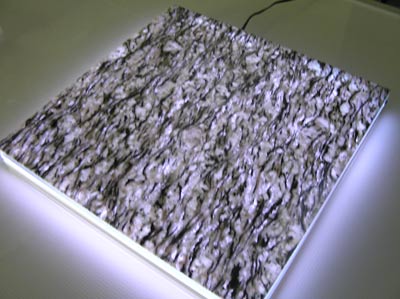
MARBLE is the architectural workhorse of stone translucency. Composed primarily of crystalline calcite or dolomite, marble has a relatively uniform crystal structure through which light can scatter rather than simply reflect. When light penetrates marble's surface, it moves through the microscopic crystal lattice, producing the soft, diffused glow that distinguishes marble-lit interiors from any other material. The veining — those mineral impurities like iron oxide deposited during metamorphosis — acts as a light pathway, creating contrasts and depth when backlit that are simply invisible in normal reflected light.
|
| Stone veneer backlit with white light — the veining that is merely decorative in reflected light becomes the entire visual event when illuminated from behind. |
ONYX is the most naturally translucent of the common architectural stones, and the most dramatic when backlit. Unlike granite or marble — which form deep within the earth's crust under heat and pressure — onyx is a surface stone, deposited in thin calcite layers by mineral-rich groundwater over centuries, often inside limestone caves. Those layered bands of calcite create a crystalline structure that transmits light with exceptional clarity. Onyx can transmit light through slabs up to two inches thick; thin-cut onyx panels glow with an almost amber luminosity that no other stone material can match.
Thickness is the critical variable across all three. Thinner sheets allow more light through; denser crystal structures obstruct it. Modern engineered stone veneers push this to extremes — some products achieve strong light transmission at just 0.6 to 0.8 mm, bonded to fiberglass or glass substrates for structural integrity. Commercial translucent veneer systems for architectural applications typically run 1.5 to 2 mm. The Beinecke Library, as we'll see, used marble milled to 1¼ inches — a far thicker slab, but at a scale and with a structural system that made it work as architecture rather than interior surface treatment.
The Beinecke Library (1963): Architecture as Lantern
The Beinecke Rare Book and Manuscript Library at Yale University, designed by Gordon Bunshaft of Skidmore, Owings & Merrill, is among the most sophisticated uses of translucent stone in twentieth-century architecture. It is also, from the outside, one of the most deliberately deceptive buildings ever built. The exterior reads as an impenetrable stone monolith. Step inside and the same walls glow.
|

The design problem Bunshaft was solving was specific: how to house one of the world's great collections of rare books and manuscripts in a building that provided usable natural light for visitors without exposing irreplaceable materials to the ultraviolet radiation that would destroy them. The conventional response would have been to omit windows. Bunshaft's response was more inventive — he made the entire wall the window.
The marble panels — white, gray-veined Montclair Danby marble quarried in Danby, Vermont — were milled to exactly 1¼ inches (32 mm) thick. At that dimension, the stone attenuates UV radiation while admitting enough diffused visible light to fill the interior with a warm amber luminosity throughout the day. The panels function simultaneously as UV filter, light diffuser, and primary architectural surface. There are no windows in the conventional sense. The building is lit entirely by stone.
The choice of marble was itself a fallback. Bunshaft's original intent was onyx — he had been inspired, he said, by the translucent effect of what he believed was onyx in a Renaissance palace in Istanbul, later identified as the alabaster of the Dolmabahçe Palace hammam. When sufficient onyx for a building of that scale could not be sourced, Vermont marble became the material of record. It proved to be the right substitution: marble's slightly denser crystal structure produces a softer, more even diffusion than onyx, appropriate for a building whose program demanded controlled, consistent illumination throughout.
The structural system that makes this possible is as carefully resolved as the material choice. The marble panels carry no load — they are infill within a Vierendeel welded steel truss system, with the trusses clad in light gray Vermont Woodbury granite on the exterior. The entire façade weight transfers to four massive concrete corner piers, each driven 50 feet to bedrock. This resolution is what allows the ground-floor lobby to be almost entirely glazed — the heavy stone cube floats above its base, with the six-story glass tower of rare books visible through the open ground level beneath it.
As the sun moves through the day, the intensity and color temperature of the interior light shifts continuously. The building performs differently at noon than at four in the afternoon, in overcast light versus direct sun. It is a building that changes character without changing at all — the same marble wall, the same fixed stone, producing an endlessly variable interior condition driven by the clock and the season.
Below the plaza, a sunken sculpture garden by Isamu Noguchi extends the material logic downward. Noguchi used exclusively white marble in deference to the geometry of the building above. Three abstract forms occupy the plantless space: a pyramid representing earth and the past, a disc representing the sun, and a cube representing chance. The same material that forms the luminous wall above becomes contained landscape below.
Contemporary Applications: LED and the Control of Color
The Beinecke relies entirely on natural light. The stone does not change — only the sun does. Contemporary applications of backlit stone introduce a new variable: the artificial light source itself becomes a design element, tunable in intensity, color temperature, and hue.
|

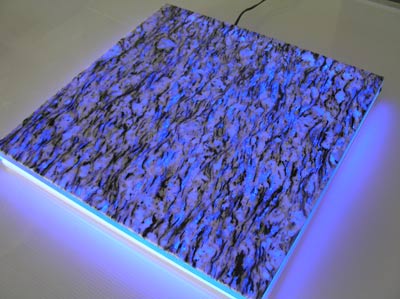
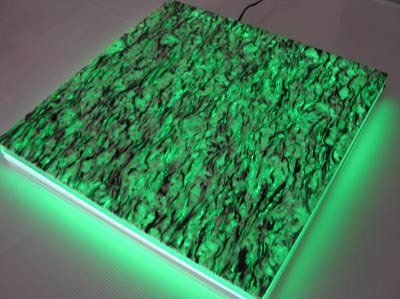
Modern thin-stone veneer systems — typically bonded to fiberglass or glass substrates at 1.5 to 2 mm thickness — are installed in front of flat LED panels. The light source can be set to warm white to draw out the amber and gold tones inherent in stone veining, cool white to clarify and flatten the surface, or full-spectrum color to transform the wall entirely. Neutral-toned onyx and white marble respond especially well to color-shifted light, acting as natural diffusers that blend the colored illumination with the stone's own internal pattern.
|
| The same panel as above, now backlit with blue light. Color temperature alone reads as an entirely different material. |
The installation logic has its own discipline. For standard-format panels, a frosted acrylic diffuser of around 4 mm sits between the LED source and the stone face, evening out light distribution before it enters the stone. For large-format installations, 8 mm acrylic provides the necessary structural support. A minimum air gap of approximately 60 mm between light source and stone face is maintained to ensure even coverage across the panel. Frosted acrylic consistently outperforms clear for eliminating hot spots from strip or point sources — the diffusion happens in the acrylic layer, and the stone above it receives light as an even field rather than a pattern of bright lines.
|
| Flat LED panel with green light — the full-spectrum tunability of LED opens up color effects that natural light alone could never achieve. |
The contemporary commercial version of this technique — hospitality reception desks, bar counters, feature walls, elevator lobbies — compresses what Bunshaft achieved at building scale into interior surface applications. The fundamental principle is identical: stone reduced to a membrane, with light delivered through rather than onto it.
The Paradox of the Glowing Wall
What makes backlit stone compelling as an architectural technique is the reversal it performs. Stone in most buildings is read by reflected light — it is an opaque surface that bounces illumination back to the eye. Backlit stone inverts this completely. The stone is no longer a surface. It becomes a depth — a glowing volume through which light moves. The veins that are decorative detail in conventional stonework become structural in the optical sense: they are the pathways light takes as it passes through the material.
Bunshaft understood this in 1963. He designed a building whose exterior promises one experience — solid, impenetrable, monolithic — and whose interior delivers something entirely different. That reversal was the central architectural idea. The building is a paradox made of marble and light.
The contemporary version of the technique has smaller ambitions — a reception desk, a bar back, a feature wall — but the phenomenological effect is the same. Ancient stone, reduced to a membrane, illuminated from behind, reveals something that was always there but never visible: the interior life of the rock.
Further Reading
Comments
Post a Comment