Stressing the Post Tensioned Cables in a Monolithic Slab
Stressing the Post-Tensioned Cables
Construction / Post-Tensioned Concrete / Goldstein Residence Updated February 22, 2026 — Technical breakdown of the hydraulic tensioning phase.Once the monolithic concrete slab has cured to its design strength—typically 3,000 psi—the most dramatic phase of the engineering begins: Stressing.
In these photographs from the Nicholson Architects archive at the Goldstein Project, we see the crew operating the hydraulic stressing jacks along the perimeter of the slab. This is not a final inspection or a finishing step. It is the moment the building becomes structurally active—the instant the passive assembly of concrete and steel transforms into a system under load.
 Operating the stressing jack on the post-tensioned cables — Goldstein Project
How the Stressing Jack Works
The jack is placed over the exposed ends of the internal steel tendons projecting from the slab edge. Connected to a high-pressure hydraulic pump and gauge, it grips the cable and pulls it with thousands of pounds of force. As each tendon stretches under load, it compresses the concrete slab from the inside out—putting the entire mass of the structure into active, permanent compression.
 Inserting the stressing jack onto the tendon — the jack grips the exposed cable end and pulls against the embedded anchor
Why We Pre-Load the Architecture
This compression is precisely what makes the extreme cantilevers of the finished Infinity Tennis Court possible. By placing the slab under constant internal tension, the structural engineer has essentially created a rigid spring capable of supporting enormous loads across a thin profile—without sagging, cracking, or deflecting under live load.
Once the jack reaches the target pressure specified on the shop drawings, the operation stops. The elongation—how far the steel actually stretched—is measured and logged against the engineer's calculation. If the numbers match, the tendon is released, the wedges lock, and the force transfers permanently into the slab. The excess cable is then cut flush, and the anchor pocket is grouted to a seamless finish.
 Stressing jack extended to full stressing pressure — the gauge confirms the load before the tendon is released and locked
Inspection: Measuring the Elongation
An inspector documents the stressed length of each individual tendon. This measurement—the elongation—is the physical proof that the cable performed as the structural model predicted. Too little elongation means the load didn't transfer. Too much suggests a problem with the anchor or the cable path. Every tendon is checked, recorded, and signed off before the forms are stripped.
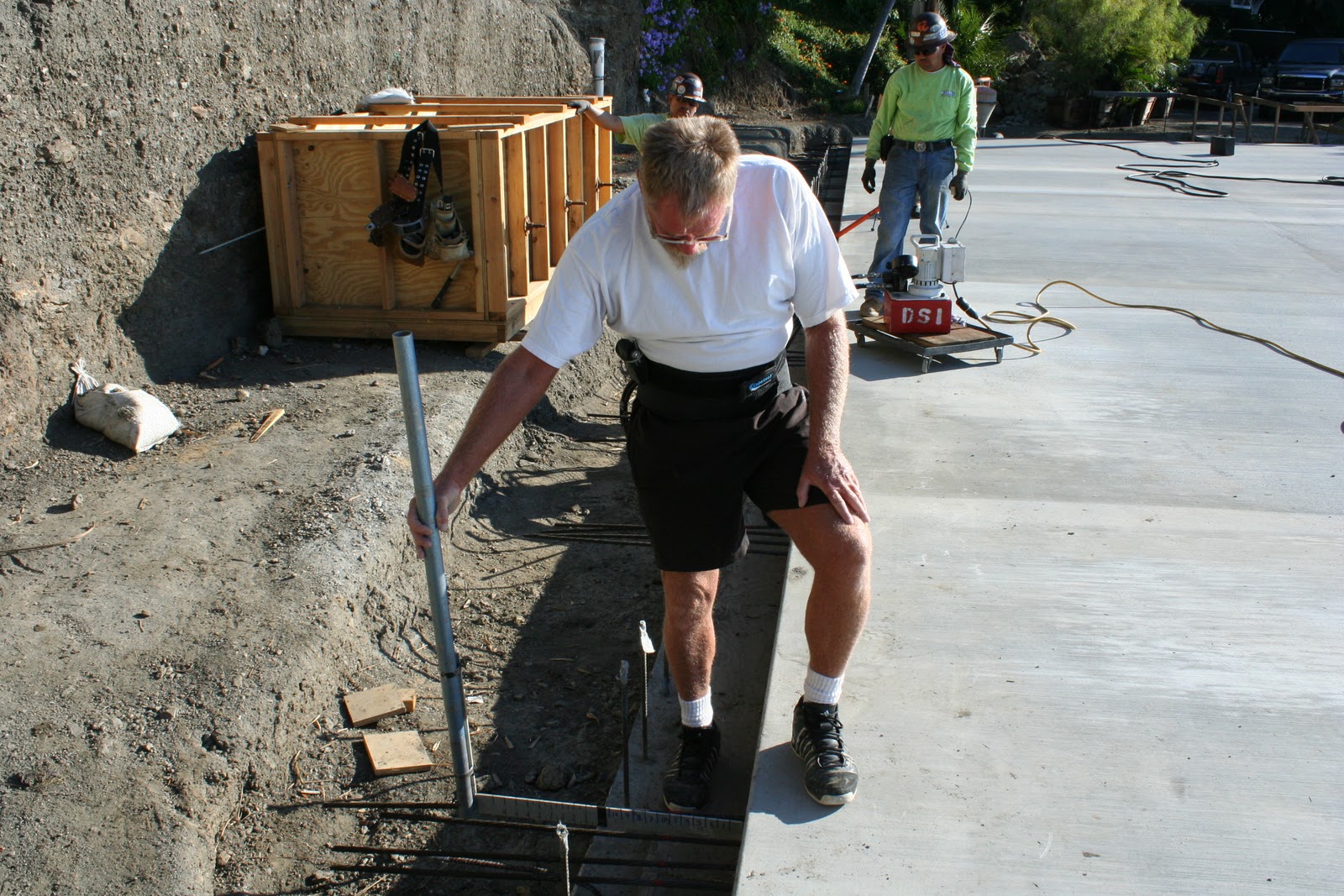 Inspecting the stressed length of each post-tensioned tendon — elongation is measured and logged per cable
 Hydraulic pump with pressure gauge — the pump drives the jack and holds the load while elongation is measured
Photographs: Nicholson Architects — Goldstein Project
Comments
Post a Comment