The Eternal Project - La Sagrada Familia
Editor's Note · May 2026
I originally wrote this post in October 2011, when the central towers of the Sagrada Família were barely stubs above the nave. The 2026 completion target felt, frankly, like an act of institutional optimism. I've kept my original notes intact below — faults and all — followed by a practitioner's reading of what actually happened.
Original Post · October 2011
Building a Masterpiece
In the heart of Barcelona, a structure defies the ordinary constraints of time. The Sagrada Família was conceived by Antoni Gaudí not as a commission to be completed, but as a life's work — a building that was always meant to outlast its architect. Construction began in 1882 under a different hand. Gaudí assumed the role of lead architect in 1883, at thirty-one, and immediately began dismantling the existing plans. What replaced them was something the architectural world had not seen before and has not quite seen since.
Gaudí's structural logic was derived not from precedent but from physics. He worked extensively with hanging chain models — funicular models — to determine load paths that could eliminate flying buttresses entirely. The catenary arch, inverted in tension, became compression in stone. The branching columns of the nave interior are not decorative; they are a literal diagram of how force travels from roof to foundation. This is not a Gothic cathedral with Expressionist ornament applied to its surface. It is a building where ornament and structure are the same thing.
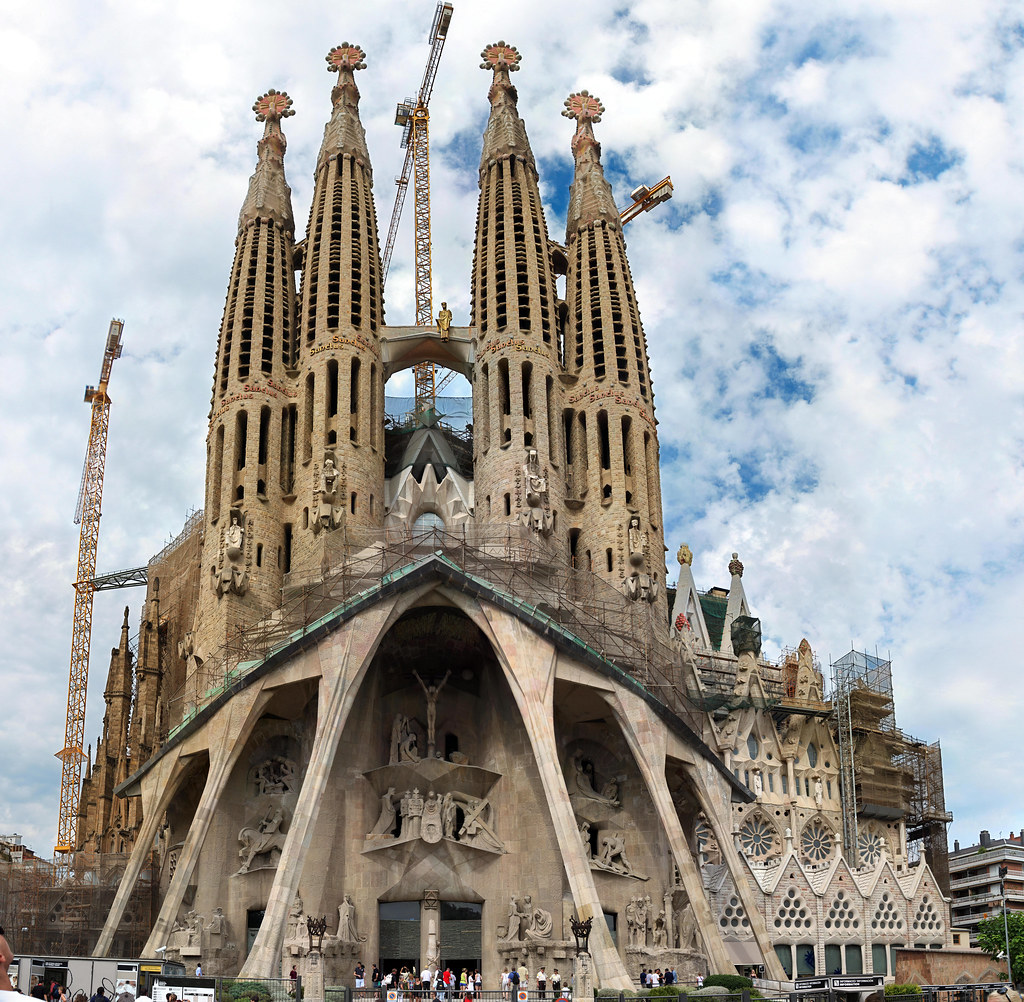
|
| Passion Facade entrance, still under construction. Photo: William Hall |
Gaudí died in 1926, struck by a tram, buried in the crypt beneath the church he never finished. The Spanish Civil War burned his workshop and destroyed most of his physical models. What survived was reconstructed — painstakingly, fragmentarily — from photographs and the memories of his collaborators. The architects who have carried the work forward since then have done so without the complete instructions. They've been working from an idea.
In 2011, the target completion date is 2026 — the centenary of Gaudí's death. Standing here now, watching the cranes work above the nave, it seems both inevitable and impossible. The central tower complex, including the 172.5-meter Tower of Jesus Christ, has not yet broken above the roofline. The technology driving the current pace — CNC stone cutting, parametric modeling, digital fabrication — didn't exist when Gaudí was alive. He would have used it without hesitation. The man built physical computers out of hanging chains; he was always working at the edge of what geometry could do.
"My client is not in a hurry."
— Antoni Gaudí
When completed, the Sagrada Família will accommodate 13,000 people within its nave. Eighteen spires will mark the skyline. It will be, by height, the tallest church building in the world. All of this funded entirely by ticket sales — no government subsidy, no single patron. The public has been paying for its own cathedral, one entry fee at a time, for over a century.

|
| Exposed rebar in concrete construction. Photo: Etan Tal |

Practitioner's Reading · 2026
What Completion Actually Means

|
| A crane lifts the final arm of the cross onto the Tower of Jesus Christ, February 20, 2026. (AP Photo/Emilio Morenatti) |
On February 20, 2026, the final arm of the 17-meter cross was lifted by crane onto the apex of the Tower of Jesus Christ. The building reached its full designed height of 172.5 meters — by a margin of a few centimeters, the tallest church structure on earth, surpassing the Ulm Minster after 130 years of holding that title. The centenary had been met.
What strikes me most, returning to my 2011 notes, is how thoroughly I underestimated the structural ambition of the tower complex. The six central towers — the four Evangelists, the Virgin Mary, and the central Jesus tower — are not additive elements, stacked vertically like conventional steeples. They are an integrated structural system. Each tower's cross-section changes as it rises, transitioning from square to dodecagonal to stellated, shedding mass in a way that's simultaneously sculptural and load-rational. The ceramic cladding on the upper shafts, fired in colors calibrated to catch Barcelona's particular quality of Mediterranean light, isn't decoration applied after the fact. It's the building's skin performing its last structural duty: weatherproofing geometry that couldn't be achieved any other way.

|
| The upper arm of the cross lowered into position at the summit. (©Basílica de la Sagrada Família, Barcelona) |
The question I keep returning to, as an architect, is what "completion" actually means for a building whose original architect died a century ago, whose documentation was largely destroyed in a war, and whose guiding intelligence had to be reconstructed from fragments. The current team under Jordi Faulí has worked from digital reconstructions of Gaudí's surviving plaster models, extrapolated through parametric modeling into geometries that Gaudí could only have studied at 1:10 scale. They are not forgers — they are, in the most literal sense, completing a thought that someone else began. That is a different kind of architectural act than anything in conventional practice.
The branching columns are not decorative. They are a diagram of how force travels from roof to foundation — structure and ornament as the same thing.
What hasn't been completed — and won't be until well into the 2030s — is the Glory Façade, the principal entrance on the south side facing Carrer de Mallorca. This is the façade Gaudí considered the most important of the three, the one dedicated to the resurrection and glory of Jesus. It is also the one for which the least documentation survived. The architects working on it now are operating with the widest interpretive latitude of the entire project, which means they carry the most responsibility and the most exposure to the essential problem of the building: at what point does continuation become invention?
That question doesn't diminish what happened on February 20th. A cross reaching 172.5 meters above sea level in Barcelona, catching light on ceramic surfaces that Gaudí specified in principle a hundred years ago — that is not a compromise. That is one of the most extraordinary acts of architectural continuity in the history of building. The hurry, as I wrote in 2011, finally seems to be over. The Eternal Project has found its height. The rest is finishing work.
References
An Architectural Humanism, 2010
Wikipedia: Sagrada Família
Sagrada Família Foundation: Architecture History
Vatican News: Cross Completed, February 2026
Comments
Post a Comment