Aaron Green on Palos Verdes
Organic Architecture · California
The Anderson Residence
Aaron G. Green, 1959 — Rancho Palos Verdes, California
 |
| Anderson Residence · Aaron G. Green · 1959 · Rancho Palos Verdes, California |
The design begins before you reach the front door. Turning onto Sea Cove Drive on the Palos Verdes Peninsula, the first thing you encounter is a custom gate set into a low horizontal stone wall at the property line — the stonework laid in the same irregular coursing you will later find at the interior fireplace. It is a quiet signal, easy to miss. Green is telling you, before you have even entered the property, that this place is conceived as a whole. The boundary wall is not a contractor's afterthought. It is the first line of the architecture.
Past the gate, the house presents itself as a low redwood structure — horizontal, discreet, its back turned to the street. The Pacific fog does what it does. Nothing in the street elevation prepares you for what lies beyond.
You enter through a recessed threshold, almost cave-like, the space compressing around you. And then the house opens — in two directions at once — and the Pacific Ocean fills the room from floor to ceiling. Abalone Cove below. Catalina Island on the horizon. The compression releases into something close to overwhelming.
This is the Anderson Residence. It was designed by Aaron G. Green and completed in 1959. It is one of the finest houses on the California coast, and most people have never heard of it.
 |
| Entry gate and property wall · The design begins at the boundary · Stone coursing continues at the interior fireplace |
House Tour
Alan Hess Inside the House
Architect and historian Alan Hess — who curated a dedicated exhibition on Green's work at the Palos Verdes Art Center — filmed this tour inside the Anderson Residence. It is one of the only existing documents of the house in use, and Hess's reading of the spatial sequence is essential viewing for anyone serious about the organic tradition in Southern California.
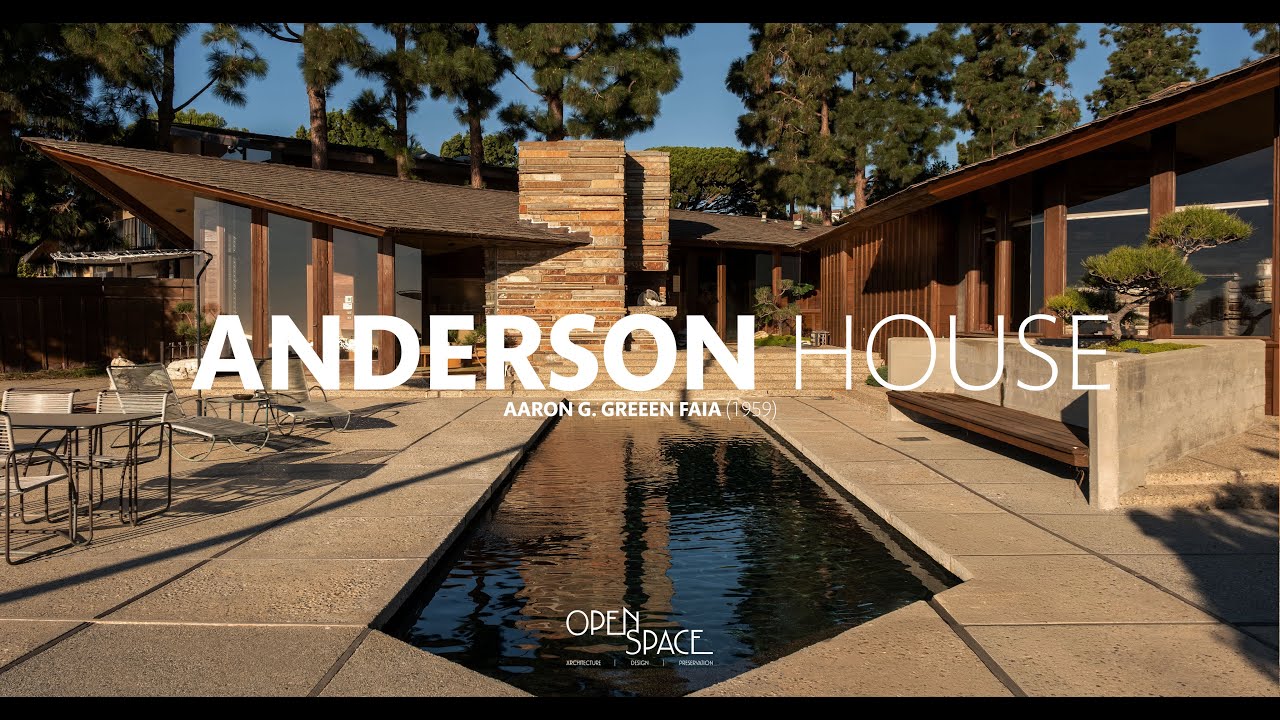
▶ Watch on YouTube
Alan Hess · House Tour · Anderson Residence · Rancho Palos Verdes
The Architect
Aaron Green: Wright's Only Associate
Aaron Green (1917–2001) was born in Corinth, Mississippi and raised in Florence, Alabama, where the bold concrete infrastructure of the Tennessee Valley Authority's hydroelectric dams gave him his first sense that architecture could be something genuinely landscape-scaled. He studied at Cooper Union in New York, where he encountered a 1938 issue of Architectural Forum devoted entirely to Frank Lloyd Wright. Wright had not been part of the curriculum. Green immediately drove to see Wright's Rebhuhn House in Great Neck, Long Island, and was converted on the spot.
His introduction to Wright set the tone for everything that followed. When a family in Florence asked Green to design them a house, he persuaded them to hire Wright instead. The result was the Rosenbaum House (1940) — now recognized as one of Wright's finest Usonians. Wright, notoriously protective of his clients and not given to compliments, invited Green to join the Taliesin Fellowship that same year. As Alan Hess puts it in the video above: Wright "did not give out compliments to anyone very often in his career."
Green trained at Taliesin from 1940 to 1943, then served as a bombardier in the Pacific during World War II. After the war he settled in Los Angeles, working with industrial designer Raymond Loewy before moving his practice to San Francisco in 1951. When he mentioned the move to Wright, Wright proposed something unprecedented: a joint office, with both names on the door.
 |
| aaron Green at taliesin west drafting outside |
It was the only formal business partnership Wright ever formed with a former apprentice. Wright designed the office space himself. He used it on trips to California from 1951 until his death in 1959 — eight years during which Green served as Wright's West Coast representative, troubleshooter, and construction supervisor on over thirty California projects, including the Marin County Civic Center, Wright's last and largest commission. When asked who Aaron Green was, Wright's answer was simple: "Aaron Green is my son."
Hess raises something important in the video that is easy to overlook: despite a substantial Southern California practice, Green was largely written out of the critical history of postwar California modernism. The Case Study houses got the coverage. The Eames, Ellwood, Soriano. Green, working in a different tradition — organic rather than industrial-modern — was, as Hess puts it, "kind of left out of the story." The Anderson Residence is a direct argument for why that omission needs correcting.
Site
The Cliffside at Abalone Cove
The parcel at 8 Sea Cove Drive is roughly triangular, 3.4 acres of clifftop land on the Palos Verdes Peninsula with a canyon to the east, Abalone Cove below to the south, and several hundred feet of Pacific Ocean frontage. On clear days, Catalina Island sits on the horizon. This is what architects call an edge-of-the-world site — defined by the land's termination, by the quality of light, by wind, and by a view so large it functions as the primary room of the house.
Wright taught his students to read a site before touching it — to note what is unusual about that place and use it to the fullest. At Palos Verdes, the unusual thing is everything: the topography, the weather, the ocean, the offshore winds that roll in from the southwest. Green's design does not resist any of these conditions. It uses them as its generating forces.
 |
| The cliffside site at Abalone Cove · Rancho Palos Verdes. corner glass detail. |
Plan Analysis
An L Bent at 45 Degrees
 |
| Floor plan · Drawing by Madelaine Thatcher · House Beautiful, October 1963 · Owners: Mr. and Mrs. Judge F. Anderson · Architect: Aaron G. Green · Builders: Norwood & DeLong |
The plan caption in the original House Beautiful publication (October 1963) is admirably direct: "The plan, although it may appear complicated, is essentially a simple L. Bedrooms are in one leg of the L; the living and dining areas and kitchen are in the other. Because of boundary limitations of site, the L has been bent into a 45-degree angle."
That sentence contains almost everything you need to understand the geometry. The underlying generator is an L-plan — the most rational organization for separating private (bedroom) and public (living/dining) life. Green then rotates the entire plan 45 degrees relative to the site boundary, creating the V or chevron reading that makes the house read as more complex than it is. The rotation is not formal. It is a direct response to two site conditions: the triangular shape of the parcel, and the prevailing offshore winds from the southwest.
The plan note is explicit about the wind: the upper left-hand corner of the house "points into the offshore winds of the area so that the L, wrapped around the dining terrace and partially around the pool, shelters these areas, makes them habitable on windy days." The geometry is climatically derived. Green is solving a real problem — how to make outdoor living possible on an exposed cliffside — and the V-plan is the answer.
The plan breaks down into four distinct zones reading from upper-left to lower-right: the service block (garage, kitchen, storage, heater room) tucked into the narrow northern apex of the triangular site; the Entrance Hall — a narrow diagonal corridor at the elbow of the L that serves as the spatial hinge of the entire composition; the private wing (two bedrooms, master bedroom with dressing bath, sleeping patio, walled garden) running northeast; and the public wing (dining, living, gun room) fanning outward toward the ocean terrace and pool to the south.
The Entrance Hall is the key. It is the compressed moment — what you experience as the cave-like threshold — and it is geometrically exact: the pivot point where the 45-degree rotation occurs, the place where service separates from living, private separates from public, and arrival gives way to revelation. The pebble-aggregate floor that runs continuously from the exterior terrace into the interior is already present in this hinge space, announcing before you reach the living room that the boundary between inside and outside has been dissolved.
Architecture
Inside and Outside as One
The sharply gabled rooflines extend outward in both directions along the V, appearing to float above the living space rather than enclose it. This is the move that makes the house feel larger than its 2,175 square feet: the roof provides shelter without creating containment. Below it, the walls — where they exist — dissolve into glass. Extensive glazing along the ocean-facing elevations frames specific views while eliminating the conventional line between interior room and exterior landscape.
 |
| Interior image looking towards the v of the plan |
The material palette is as deliberately limited as the plan. Redwood — left unpainted throughout, contributing its grain and natural weathering to the interior surfaces. Mahogany for cabinetry and built-ins. And stone — the same irregular coursing that appears in the boundary wall at the property line reappears at the interior fireplace. This is not coincidence. Green is drawing a continuous thread from the first moment of arrival through to the most intimate space in the house. The stone is the same stone. The design is one unbroken gesture from property edge to hearth.
And then the pebble-aggregate concrete floor — perhaps the most important material decision in the house: it runs continuously from the exterior terrace into the interior, making the floor a single uninterrupted surface that refuses to acknowledge the wall as a threshold.
Curtis Besinger, writing in House Beautiful in October 1963, identified this as the house's defining quality: the floor you see underfoot continues the exposed aggregate pavement from outside; the walls inside are the same as those outside; the same ceiling continues overhead. The absence of demarcation, he wrote, stems from the fact that inside and outside were conceived and planned as one continuous area. That is not a description of a spatial effect. It is a description of a design method.
 |
| sunken living room with built-in furniture. photo by kris conner. |
The built-in furniture — seating, cabinetry, bookshelves — is integrated into the structure rather than placed within it. This is standard organic practice, inherited directly from Wright: the house is not a container for furniture but a complete spatial environment in which every element is designed as part of the architecture. The result is an interior of unusual coherence. Nothing is extraneous. Everything belongs.
Philosophy
Not Imitating Wright — Applying His Principles
Alan Hess uses the phrase "organic modern" to describe the Anderson Residence, and it is the right formulation. He is also careful to note what it does not mean: the word style was, in his words, "anathema to Frank Lloyd Wright." A style, in Wright's framing, was something applied to a building after the fact — Gothic ornament on a Gothic building, classical ornament on a classical one. Organic architecture was the opposite of that. It grew from the inside out.
Hess uses a tree as his analogy: a tree has trunk, branches, leaves, flowers, roots — entirely different elements with different functions — but as a totality they create a unified organic whole. That is how Green thought about the structure and space of this house. Not as a collection of designed elements but as a single organism, each part expressing its function while contributing to the unity of the whole.
What is important to understand — and what Hess is clear about — is that the Anderson Residence is unmistakably not a Frank Lloyd Wright design. Green was not imitating Wright's formal vocabulary. The angular geometry, the material palette, the spatial sequence are all recognizably Green's own. What connects it to Wright is not appearance but principle: nature as the generator of form; materials used honestly; interior and exterior conceived as continuous; the spaces of daily life — cooking, sitting by the fire, sleeping, eating outside — organized as a unified totality rather than a sequence of separate rooms.
 |
| exterior pool courtyard with built-in seating |
Preservation
Almost Exactly as Built
The Anderson Residence has been exceptionally well preserved. Few fundamental changes have been made since its completion in 1959 — a remarkable fact for a house that has passed through multiple owners over sixty-five years. The most significant addition is a pool and spa by Eric Lloyd Wright — Frank Lloyd Wright's grandson — handled with sensitivity to Green's original design language. What you see today is, in most essential respects, what Aaron Green built.
The house was featured in House Beautiful in October 1963, photographed by Maynard Parker — one of the defining architectural photographers of the mid-century period. Those images, alongside the Madelaine Thatcher plan drawing reproduced above, remain the primary published documentation of the house. The Palos Verdes Art Center mounted the first dedicated exhibition on Green's work, curated by Alan Hess, specifically because his contribution to Southern California architecture had gone largely unacknowledged by the major cultural institutions.
 |
| Living room looking out toward the view beyond. photo by kris conner. |
Standing in the living room of the Anderson Residence, looking south over Abalone Cove, the house disappears. That is the intended effect. Green did not design a building to look at. He designed a building to be inside — one in which the experience of the site, the weather, the ocean, the quality of afternoon light on the concrete floor, takes precedence over the experience of the architecture itself. The architecture enables all of it and then steps back.
That kind of self-effacement is the hardest thing to achieve in architecture, and it is what the organic tradition — from Sullivan through Wright through Green — was always pointing toward. Not buildings that announce themselves, but buildings that deepen your experience of being alive in a place.
The Anderson Residence is worth the drive to Palos Verdes. It is worth understanding. And Aaron Green is worth knowing.
"What you see here is Aaron Green's concept of space, structure, site, nature — all of those things. It's just an extraordinary artifact to come upon."
— Alan Hess, architect and historian
Architectoid · Organic Architecture Series
Sullivan → Wright → Green
Comments
Post a Comment