The Only Usonian in Southern California — Frank Lloyd Wright's Sturges Residence
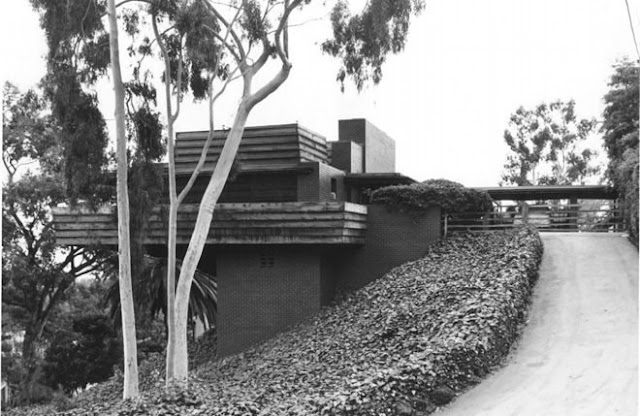 |
| Sturges Residence, Brentwood Heights, Los Angeles. Photo: Julius Shulman Photography Archive, Getty Institute |

In January of 1938, George and Selma Sturges picked up a copy of Architectural Forum. The entire issue was devoted to Frank Lloyd Wright — his philosophy, his materials, his argument about what an American house could be. On pages 80 and 81, they found something that stopped them: a ground floor plan for a small house in Madison, Wisconsin. The Herbert A. Jacobs Residence. Total cost: $5,500, including the architect's fee of $450.
They wrote to Wright. He responded. George Sturges, a Lockheed engineer, sent Wright a careful drawing of their steep hillside lot in Brentwood, California. Within months the design was finished. Wright's most trusted apprentice was already in Los Angeles. He assigned him to the project. Los Angeles Organic Architecture had found its first Usonian address.
To understand the Sturges Residence, you have to start with the plan the Sturgeses saw in that magazine. The Jacobs House in Madison, Wisconsin is the first fully realized Usonian — a word Wright coined from "United States-ian" to describe a new type of modest, democratic, American house. No basement. No attic. No garage. A carport. Radiant heat in the slab. Materials native to the region. An L-shaped plan that oriented the enclosed private rooms toward the street while opening the living spaces entirely toward the garden.
Wright had built in Los Angeles before. The Hollyhock House (1921) and the Ennis House (1924) both preceded the Sturges Residence, but they belong to a different phase of Wright's thinking — the textile-block period, with its pre-cast concrete units and California Romanza ornament. Those buildings are monumental, archaeological, heavy with pattern. The Sturges Residence is something else entirely: the mature Usonian philosophy applied to California for the first time. It is the only building of its type he ever built in Southern California.
 |
| Plans for H. A. Jacobs House, Madison, Wisconsin — published in Architectural Forum, January 1938. This is the plan the Sturgeses saw. |
The Jacobs House sits on flat land. Its plan is organized on a strict two-foot orthogonal grid — every wall, every opening, every built-in aligned to the same module. The geometry is absolute but never mechanical; the grid enforces discipline without imposing rigidity. The result is a house that feels both inevitable and warm, because every decision derives from the same underlying unit rather than from aesthetic preference applied after the fact.
This is what the Sturgeses were responding to when they wrote their letter. Not just the look of the building — the logic of it. The sense that this is what a house can be when it grows from a clear idea rather than assembles from borrowed parts.
The Sturgeses purchased their lot in Brentwood Heights on September 1, 1938, for exactly ten dollars. The land was cheap for a reason: it dropped steeply away from the street, a hillside site that no conventional builder would have touched without either cutting a massive pad or building a towering foundation wall. Both solutions would have destroyed what made the site interesting — the view west across the Los Angeles basin toward the ocean, the sense of being elevated above the city without being separated from the landscape.
Wright saw it differently. The steep slope was not a problem to overcome — it was the design. The same orthogonal grid that organized the Jacobs House on flat Wisconsin ground was applied here, but where the Jacobs House extends its living spaces horizontally across a lawn, the Sturges Residence projects them outward over the hillside. The cantilever that results is not a structural trick. It is what happens when you apply the Usonian grid honestly to this particular piece of California earth.
The structural reality of that cantilever immediately ran into Los Angeles. Wright's original design used timber joists and diagonal braces to carry the cantilever — the same wood-based structural logic he had used at the Jacobs House on flat ground. The Los Angeles County Building Department, applying seismic code, mandated the addition of steel in several locations. Three successive permits were issued: the original in August 1939, and two more in October and November, each adding more steel. The changes were costly and reportedly enraged George Sturges — an engineer himself, who understood exactly what was being overruled.
The parallel to Fallingwater is instructive. At Fallingwater, Wright ignored his engineer's recommendations and won the argument on site — but the cantilevers were ultimately failing decades later and had to be rebuilt. The Sturges Residence avoided that fate precisely because the LA Building Department would not be argued past. The machine was not chosen; it was imposed. And it is what makes the building still standing today. Lautner, who managed those three rounds of structural revision on his very first Los Angeles project, absorbed that lesson for the rest of his career.
 |
| Sturges Residence floor plan & section — 449 North Skyeway Road, Brentwood Heights, Los Angeles |

 |
| Sturges Residence, Brentwood Heights, Los Angeles. View from carport Photo: Julius Shulman Photography Archive, Getty Institute |
The house is small by every measure except ambition. At 1,200 square feet, it is a single-story structure of redwood, brick, and steel-reinforced concrete. The material palette is identical to the Jacobs House DNA — brick for the chimney and structural piers, redwood board-and-batten for the horizontal cladding that Wright used to pull the building down toward the earth even as it floats above the hillside. The same materials that look modest on a flat Wisconsin lot become monumental when cantilevered over a Brentwood slope.
The interior is organized as a single open living volume with two bedrooms, the whole thing lit from above by clerestory windows that run the length of the structure. The living room does not merely look out at the view — it extends into the view through a 21-foot wrap-around deck that projects over the hillside without visible support from below. From the street, the house appears to hover. From inside, sitting at the level of the treetops, you are both enclosed and released into the landscape at the same time. That spatial paradox — shelter and exposure simultaneously — is what Wright meant when he called it one of the best things they had done.
Wright was designing this building during the same months he was finishing Fallingwater — a coincidence worth sitting with. The two buildings share the same fundamental gesture: structure cantilevered over a dramatic natural feature, the floor plane extending into space, the building insisting on its relationship to the landscape below rather than turning away from it. Fallingwater does this at the scale of a Pennsylvania waterfall. The Sturges Residence does it at the scale of a $10 Brentwood hillside. The idea is the same. The scale changes nothing about the idea.

In A Testament (1957), Wright codified the nine principles of Organic Architecture that had governed his work since the Prairie House period. He had not yet formalized them when the Sturges Residence was built in 1939 — but the principles describe convictions he had held for decades. Applying them here is less a historical exercise than a diagnostic: does the building that introduced Wright's mature Usonian philosophy to Southern California actually demonstrate those principles, or does the difficult site produce compromises?
| # | Principle | Present | Reading |
| 01 | Kinship of Building to Ground | ✓ Strong | The cantilever does not fight the hillside — it grows from it. The building belongs to this specific slope. It could not exist anywhere else. |
| 02 | Decentralization | ✓ Strong | The horizontal extension over the slope is the building's primary gesture. The deck reaches outward; nothing reaches upward. |
| 03 | Continuity | ✓ Partial | The slab-to-wall-to-roof reads as a single organism. The introduced steel I-beams — required by the LA Building Department — create a structural layer that is not of one material, though it is invisible from inside. |
| 04 | Nature of Materials | ✓ Strong | Redwood behaves like redwood. Brick like brick. No paint, no cladding, no applied finish conceals the material's identity. California redwood sourced locally, used horizontally — wood that looks like wood. |
| 05 | Integrity | ✓ Strong | The furnishings Lautner designed during the 1970 restoration remain. Interior and exterior read as one continuous environment. Nothing imported, nothing decorative applied from outside. |
| 06 | Space as the Reality of Architecture | ✓ Strong | The 21-foot deck does not enclose space — it releases it into the landscape. The interior living volume is inseparable from the exterior void below. The walls are not the building; the space between tree canopy and Brentwood sky is. |
| 07 | Character as Style | ✓ Strong | There is no borrowed style here. No historical reference, no ornamental layer applied to the surface. The form is entirely the result of this hill, these materials, this view, this budget. |
| 08 | Shelter as Spiritual Function | ✓ Strong | The low ceiling inside compresses you; the deck releases you. The building creates the experience of shelter precisely by contrast with the vast exposure of the hillside view. 1,200 square feet that feel monumental. |
| 09 | The Machine Redeemed | ✓ Tension | The steel that the building department required is the most interesting note in this analysis. Wright's timber framing was overruled by seismic code — the machine was imposed, not chosen. Yet it is what makes the cantilever stand. Technology serving organic ends despite arriving under compulsion. Without it, the building would likely have failed, as Fallingwater's cantilevers eventually did. |
Seven of nine principles: unambiguous. Two: partial or in tension. By any standard, the Sturges Residence demonstrates what Wright was arguing for in his own framework — and the tension in Principles 03 and 09 makes the building more interesting, not less. The steel compromise is the clearest evidence that organic architecture is not a style. It is a way of working with specific conditions, including conditions you did not choose.
On February 11, 1939, Frank Lloyd Wright wrote to John Lautner: "Herewith sketches for the Sturges. I think it is self explanatory. Take it to them for their reaction. It is one of the simplest things we have done and one of the best."
Lautner had already been in Los Angeles since March 1938 — he had relocated his family from Wisconsin to oversee Wright's California work generally, arriving nearly a year before Wright drew the Sturges designs. He was there when the Sturgeses chose the lot in September. He was the one who showed them the finished plans and wrote back to Wright that they were "magnificent — they are all smiles, and I can see why." He was on site when construction began in August 1939, when the building department required the first steel beams in October, and when the second and third rounds of structural reinforcement came through in November. He was there when the house was substantially complete in December.
Wright visited the site once, in June 1939, for a pre-construction meeting with Lautner. Everything else was Lautner. He translated the drawings into a standing building on a steep hillside in a city with seismic codes that Wright had not fully anticipated. He managed the structural compromises, kept the design intent intact, and delivered the building that Wright called one of the best things they had done.
Lautner never left Los Angeles after the Sturges. He launched his own practice almost immediately — a natural progression, since Wright had given him not just a commission to execute but a city to understand. The things Lautner learned on this project — how to cantilever over steep Los Angeles topography, how to negotiate between structural purity and seismic code, how to make a small house feel vast by connecting it to the landscape below — these are not incidental biographical details. They are the foundation of everything he built afterward.
The Chemosphere (1960) is the Sturges cantilever taken to its logical extreme: the hillside so steep that the only honest structural response is a single column and a cantilevered octagon above it. The Sheats-Goldstein Residence (1963) applies the same hillside logic to a larger program — the building does not fight the slope, it makes the slope the reason for every design decision. Silvertop (1963) extends the cantilever into a continuous concrete shell. In each case, the origin is traceable. The Sturges Residence was where Lautner first learned that a building could belong to a Los Angeles hillside rather than simply occupying it.
The house passed through several owners before actor and playwright Jack Larson — best known as Jimmy Olsen in the 1950s Adventures of Superman — purchased it with director James Bridges in 1967. By then, earlier owners had painted the exterior black and orange. Larson and Bridges hired Lautner — the same man who had built the house twenty-eight years earlier — to restore it. Lautner sandblasted the exterior and interior back to their original material character, and designed new furnishings that remain in the house today. In 1979, after a eucalyptus tree collapsed onto the northeast deck, Lautner returned again to supervise its reconstruction.
The building was designated Los Angeles Historic-Cultural Monument No. 577 in May 1993. It remains a private residence today, at 449 North Skyeway Road in Brentwood Heights. It can be viewed from the street below.
Wright's description of the Sturges Residence as "one of the simplest things we have done and one of the best" is not false modesty. It is a precise architectural observation. The building does not attempt anything that its materials, its site, and its budget cannot support. It applies a single coherent idea — the orthogonal Usonian grid extended over a steep hillside by cantilever — and follows that idea to its natural conclusion. There is no decoration. There is no borrowed style. There is no structural system in conflict with the program. There is only the hill, the view, the redwood, the brick, and 1,200 square feet of carefully organized space floating above Brentwood.
And there is the young Taliesin apprentice who built it, who stayed in Los Angeles because of it, and who would spend the next four decades proving that the thing he learned on this hillside in 1939 was not a lesson about one building. It was the whole idea.

- Sturges House — Owner Documentation Site
- George Sturges House — Wikipedia
- Architectural Forum, Vol. 68, No. 1, January 1938 — H. A. Jacobs House plans, pp. 80–81
- Frank Lloyd Wright, A Testament (Horizon Press, 1957)
- John Lautner, Responsibility and Integrity — Oral History, UCLA / Internet Archive
its nice architecture
ReplyDeleteor artical or blogs..
that architecture plan is amzing
if you search any architecture plan like this
its avaible now you can search on our cadbull website
cadbull free houe plan or cadbull.com
or check out my beautiful house plan :-https://cadbull.com/amp/122911/The-first-floor-layout-plan-of-the-bungalow-in-dwg-AutoCAD-file