Turrell Skyspace at Rice University
Light + Space · Houston, Texas
Twilight Epiphany
James Turrell's Skyspace at Rice University
|
| Photo by Karren Warren / Houston Chronicle |
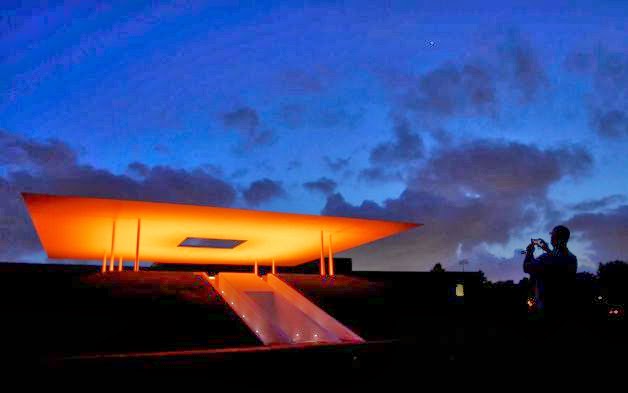
In June 2012, a grass-covered pyramid rose from the west quadrangle of Rice University's Houston campus — not quite sculpture, not quite building, not fully of the earth and not fully above it. James Turrell called it Twilight Epiphany. It was, at the time of completion, his 73rd Skyspace, and his most architecturally ambitious.
The structure is a 118-foot-square earthwork: a truncated pyramid of grass berms rising at a precise 19-degree slope, enclosing a below-grade viewing chamber measuring 28 feet square. Above it, a 72-foot-square white canopy floats on just eight 6-inch steel tube columns — paired at the corners, nearly invisible — hovering 21 feet in the air. At the canopy's center, a 14-by-14-foot aperture opens directly to the sky. The whole assembly is simultaneously massive and weightless.
"This is architecture that light and space makes."
— James Turrell
The interplay Turrell is after is perceptual, not decorative. LED lighting embedded in the canopy's underside is programmed for two daily light shows keyed precisely to sunrise and sunset. The morning sequence begins forty minutes before first light; the evening sequence traces the sun's disappearance. As ambient light shifts, the LEDs shift with it — cycling through soft golds, electric rose, deep purple — so that the fixed rectangle of sky overhead appears to change color, to advance and recede, to become something other than sky. It is the same optical phenomenon Turrell has pursued for five decades: the eye cannot locate the boundary of color in space, so perception itself becomes the subject.

|
| The lower-level chamber with Texas pink granite benches — Photo by Karren Warren |
Architecture of Earth
What distinguishes Twilight Epiphany among Turrell's Skyspaces is its relationship to the ground. Most of his earlier works occupy rooms — carved into existing buildings or set within gallery walls. Here, the structure is the landscape. Visitors descend into a sunken chamber lined with benches of Texas pink granite, seating 44 people below grade, while an upper-level terrace of precast concrete holds an additional 76 viewers at the berm's rim. The total capacity of 120 reflects Turrell's intention that this be a genuinely communal space — somewhere to gather, not just contemplate alone.
The structural logic is similarly hybrid: a concrete base below grade, steel columns above, a conventional membrane roof system made radical by the knife-edge detail at its perimeter. From any distance, the canopy appears to hover without support. The grass berms read as pure landform, continuous with Rice's expansive lawns. It is a building that refuses to look like one — architecture dissolved into topography.

|
| The hovering canopy and knife-edge roof — Photo by Karren Warren / Houston Chronicle |
Light Meets Sound
Sited directly beside the Shepherd School of Music, Twilight Epiphany was the first Turrell Skyspace specifically engineered for acoustic performance. The form is not incidental to this: the bermed walls and interior geometry were developed in collaboration with Rice's music faculty to make the chamber function as a laboratory — a place where students of the Shepherd School can perform and study the relationship between sound, space, and shifting light. Live and recorded music events have been held here since opening day.
The project was made possible through the vision of Rice alumna and trustee Suzanne Deal Booth, who first encountered Turrell through her time working with art patron Dominique de Menil. The connection proved transformative. On June 14, 2012 — as the university marked its centennial — the structure was dedicated as the Suzanne Deal Booth Centennial Pavilion. Design development was carried out by Thomas Phifer and Partners, working from Turrell's own CAD drawings, with Linbeck as general contractor.
Twilight Epiphany — sunrise and sunset light sequences
Turrell's Houston
Twilight Epiphany is the largest and most visible of three major Turrell works in Houston. The others are The Light Inside (2000), the neon-lit tunnel connecting the two buildings of the Museum of Fine Arts Houston, and One Accord (2001) at the Live Oak Friends Meeting House in the Heights neighborhood — a Quaker meeting house designed in collaboration with architect Leslie K. Elkins, notable as Turrell's own religious community. Houston has, in effect, become one of the richest concentrations of Turrell work in the world.
Twilight Epiphany is free and open to the public. Sunrise and sunset light shows run daily; student docents are on-site at each evening sequence. For current schedule and weather information: skyspace@rice.edu.
Related on Architectoid
- Venice Beach Artist
- Above Horizon — Goldstein Skyspace, Los Angeles
- Restoring Above Horizon Skyspace — Conner & Perry
Architectoid · Light + Space · Houston, Texas · 2012
Comments
Post a Comment