Gregory Ain Mar Vista Tract
Los Angeles Modern
The 52-House Utopia:
Gregory Ain and the Mar Vista Tract
In 1948, an architect tried to prove that modern design belonged to everyone. The idea still works. The formula needs updating.
Architectoid · 2026
The Argument
Modern for the Middle Class
Gregory Ain believed something that most of his contemporaries talked about but never acted on: that modern architecture was a moral obligation, not a luxury service. Sullivan had argued it first — that democratic culture demanded democratic design, that the quality of a civilization could be read in the quality of its ordinary buildings. Ain took that argument literally and did something about it.
While the Case Study House program was producing aspirational photography for an imagined modern family — glass walls, open plans, beautiful objects — Ain was building for actual ones. Teachers. Veterans. Working couples buying their first house on a postwar budget. The Mar Vista Tract is the Case Study program's conscience: fifty-two houses, one floor plan, and a set of ideas sophisticated enough that they still hold up on the street.
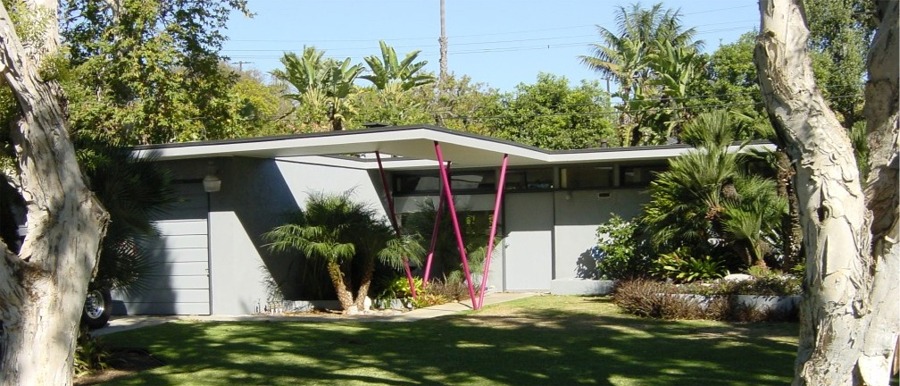
Mar Vista Tract, Los Angeles — street view
I've walked these blocks. What strikes you first is the clerestory band — a continuous strip of high windows running across otherwise modest facades, pulling light into the interior without sacrificing wall space or privacy. It's the same detail repeated across fifty-two houses, but because each house sits on the lot at a different angle, the light hits it differently on every block. The sameness is structural; the variation is architectural. That's a more difficult trick than it sounds.
The Floor Plan
One Plan, Infinite Variations
The plan itself is a piece of design thinking that deserves more attention than it gets. A series of sliding wooden panels divides — or opens — the interior depending on the household's needs on any given day. Closed down, you have three private bedrooms. Opened up, you have a living space generous enough for entertaining. It's the same square footage either way; the architecture responds to the life being lived inside it.

Floor plan diagram showing flexible sliding panel system
This is Wright's Usonian principle in practice, without the Wright price tag. The Usonian house was designed for the same demographic — the American family of modest means — and it carried the same conviction that a flexible, servant-free plan was more honest to how people actually lived than the formal room hierarchies inherited from Victorian convention. Ain understood that inheritance and rejected it just as firmly.
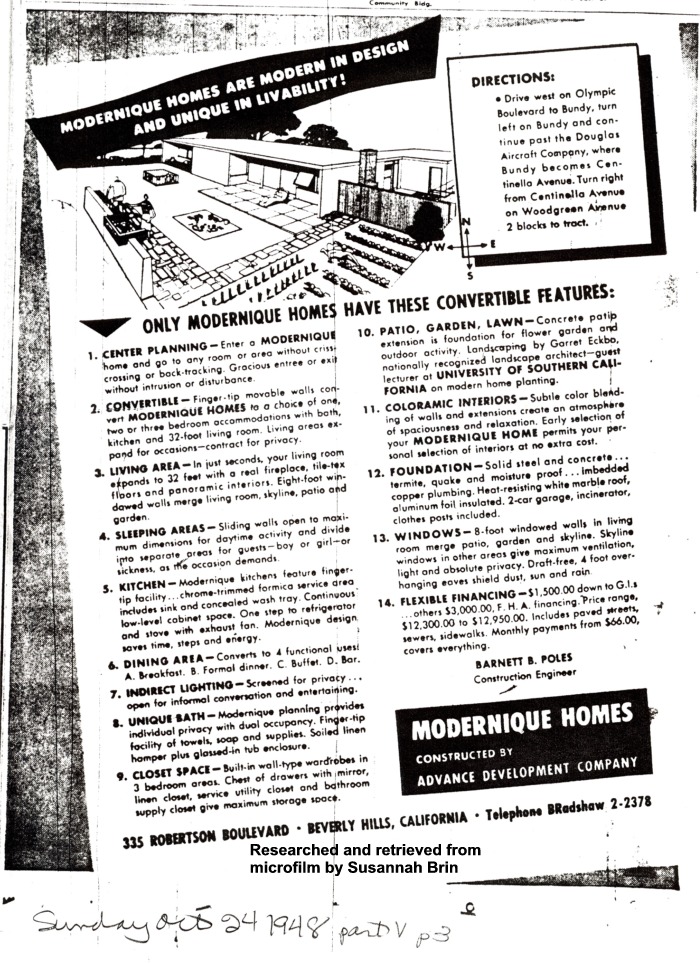
Advertisement from the Los Angeles Times, 1948
"Modernique Homes" — a blend of Modern and Unique — was the marketing name, and it was a more honest piece of branding than most. Ain really was promising both things simultaneously: the cost efficiency of a single floor plan, and the architectural intelligence to make fifty-two instances of it read as fifty-two different houses. Rotation, garage placement, and the clerestory band working in concert. On the street, it works. The variety is real, even if the bones are shared.
The Collaboration
Eckbo and the Unfenced Yard
Garrett Eckbo isn't a supporting character in this project. He's a co-author. Eckbo had studied under Gropius at Harvard, then joined the faculty at Berkeley — he came to this collaboration with as developed a philosophy about landscape as Ain had about building. The tract was designed without fences. A deliberate act, not an omission. And each backyard was planted with a different variety of fruit tree, varied by design so that neighbors would have a reason to trade, to knock on each other's door, to know each other.
This is Sullivan's democratic ethic extended into the landscape. The street, the shared edge, the neighbor — these are architectural problems. The yard as commons rather than private enclosure. It's a straightforwardly utopian idea, and like most utopian ideas it didn't fully survive contact with the families who moved in. The fences went up. The fruit trees are long gone. But the social program was embedded in the physical plan, and the physical plan is still there.
The Question
Could It Work Now — and Where?
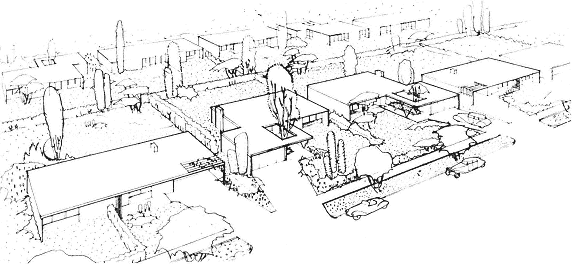
Site plan showing rotation strategy and lot organization
Not in Los Angeles. The land simply doesn't exist at the scale the model requires. The Mar Vista Tract works because it's a tract — fifty-two houses, shared landscape logic, collective identity built into the site plan. You can't replicate that on infill parcels scattered across the city. What infill gives you is one house at a time, and one house at a time is not how the Ain model generates meaning.
But in other parts of the country the land exists. The Midwest, the South, the mountain West — places where greenfield housing is still being built at scale, and where what gets built is largely indistinguishable from what was built in 1975. Ain's model is a direct counter-argument to that default. Thoughtful site orientation rather than grid conformity. Shared landscape rather than private enclosure. Flexible plans that respond to actual households. Material discipline with deliberate variation. Democratic housing doesn't require a Los Angeles zip code. It requires an architect willing to take the problem seriously.
The single-story format would need to be rethought. Current buyers expect square footage, primary suites, ADU potential — the program has grown well beyond what Ain's plan was sized for. But the organizing principles don't depend on the footprint. Rotation. Shared edge. Material consistency with planned variation. The clerestory band as unifying architectural constant. These translate at any scale. The houses are small by today's standards; the ideas are not.
Democratic housing doesn't require a Los Angeles zip code. It requires an architect willing to take the problem seriously.
The Legacy
First of Its Kind, Still Singular
The Mar Vista Tract became the first post-WWII modern district in Los Angeles to receive Historic Preservation Overlay Zone status. That designation protects the physical fabric — the houses, the street rhythm, the shared landscape geometry — and it acknowledges that something real and deliberate happened here, worth keeping.
What the HPOZ can't protect is the idea behind the form. The Mar Vista Tract remains singular not because Ain's argument failed, but because no one tried it again at scale. The Case Study Houses were photographed, published, and celebrated. The Modernique Homes sold out, housed families, and were largely forgotten by the architectural press. That's a useful piece of information about what the discipline values — and what it tends to overlook.
Walk the streets in Mar Vista and the clerestory band is still there, still catching the afternoon light across the same materials it always has. The variation in the design is still readable from the sidewalk — same bones, different orientations, different light. It still works as architecture. It still makes the case Ain was trying to make in 1948. Seventy-eight years later, in a city with a housing crisis that shows no sign of resolution, that case looks less like a historical footnote and more like an unanswered question.
Architectoid · Los Angeles Modern
every style has it's own utopya... so and modernism, but I think it contains a lot of brilliant ideas about the rational way of life!
ReplyDeleteyes, definitely some ideas are contained within, and i like the mass production approach to reduce the cost.
ReplyDelete