Wood Reborn: How Modern Timber Construction Is Changing Architecture
Materials / Structural Systems
Wood as Collaborator
Shigeru Ban and the New Language of Timber
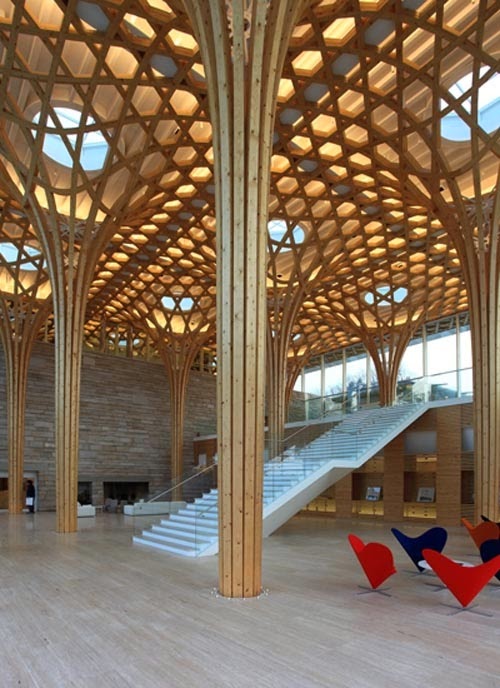
Haesley Nine Bridge Club House — Shigeru Ban Architects
Stand inside the Haesley Nine Bridge Club House in South Korea and the first impression is not of a building at all — it is of a forest. Columns rise from the floor, branch outward, and interlace into a geometric canopy overhead. The light comes from above, filtered through the structure itself. The engineering and the poetry are, for once, completely inseparable.
This is the work of Shigeru Ban, and it represents something genuinely new in the long history of timber construction.
The Material
Glulam: What the Industrialization of Wood Made Possible
Wood construction was fundamentally transformed over the last century. The development of glue-laminated timber — glulam — made it possible to achieve spans and shapes that were once unthinkable. Glulam offers roughly twice the strength-to-weight ratio of steel while remaining a renewable, workable material. For most of the 20th century, however, that potential was expressed in utilitarian terms: long-span roofs, exposed warehouse frames, the occasional church ceiling. The material was capable of more. It took a new generation of architects and computational tools to find out how much more.
At Haesley, Ban's office collaborated with Design to Production, a computational design firm that used 3D modeling to generate the geometry for 15,000 individual lap joints. The result: 3,500 custom glulam parts, each numbered and fabricated off-site, then assembled on location. The system uses complex, double-bent laminated beams — a form unlike anything previously built in timber. The light wells at the tops of the columns, allowing natural daylight and ventilation to pass through the structure, feel both ancient and entirely contemporary.
The engineering and the poetry are completely inseparable — which is the only condition worth working toward.

Bent and twisted glulam beam — Haesley Nine Bridge Club House

Interior canopy — column branching detail

Haesley Nine Bridge Club House — exterior view, 2010
Deep Root
Japanese Timber Joinery and the Logic of Load Through Geometry
The tradition Ban's work draws from runs deep. The finest timber joinery in history belongs to Japanese carpenters — the interlocking wood joints found in pagoda construction required no nails, no metal fasteners of any kind. They were so well-engineered that many of these structures have survived centuries of seismic activity. The joints distribute load through geometry rather than hardware, which means the connection becomes stronger under compression. The structure works with the forces rather than against them.
Japan has since modernized this heritage through CNC machining. Joinery that once took master craftsmen days to cut can now be produced in seconds, with every member automatically numbered for efficient site assembly. The underlying principle has not changed: wood, shaped with precision and respect, as one of the most resilient structural materials ever devised. Ban's 15,000 lap joints are a direct continuation of that logic — ancient intelligence expressed through contemporary fabrication.
Next Chapter
Mass Timber, CLT, and the Case for Wood at Scale
Beyond glulam, the story of modern timber construction has a compelling next chapter. Cross-Laminated Timber — CLT — is now enabling architects to build entire multi-story structures from wood. Panels are fabricated by layering boards at perpendicular angles under pressure, creating large-format structural slabs that behave more like concrete than traditional wood framing. Tall timber buildings — sometimes called plyscrapers — are now appearing in cities from Vancouver to Oslo, with some projects exceeding 18 stories.
From a carbon standpoint, this matters enormously. Timber stores carbon rather than emitting it during production — making it one of the most compelling structural choices available to architects working on the problem of the built environment's footprint. The same computational tools that allowed Ban's office to fabricate 3,500 custom parts are now being used to design entire neighborhoods built from engineered wood. The material is ancient. The ambition is entirely new.
Why It Matters
Structure and Beauty Are Not Separate Concerns
Trained in the organic architecture tradition — through Lautner, Wright, and Sullivan — I find the resurgence of timber one of the more encouraging developments in contemporary practice. These architects understood that the best buildings grow from their materials honestly. That structure and beauty are not separate concerns to be balanced against each other, but the same concern, approached from different angles.
What Shigeru Ban achieved at Haesley, and what Japanese carpenters perfected over centuries, is the same idea expressed across different eras: wood is not a limitation to work around. It is a collaborator. The grain, the warmth, the structural logic — all of it can be the architecture, if you are willing to let it lead.
Related
Photo sources: worldarchitecture.org · Shigeru Ban Architects
Comments
Post a Comment