Goldstein Office by Nicholson Architects
Architectoid · Los Angeles · Sheats-Goldstein Residence
The Second Office
Nicholson Architects · Sheats-Goldstein Residence · Beverly Hills
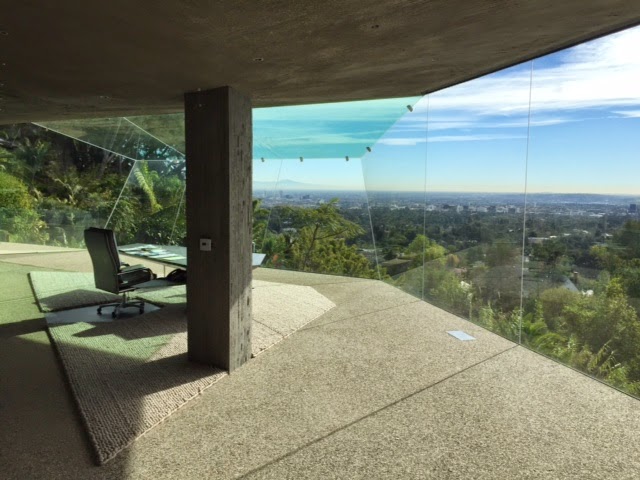
Goldstein Office, Sheats-Goldstein Residence. Nicholson Architects. Photo: James Perry.
James Goldstein's first office no longer exists — not because it was demolished, but because it was too good to leave behind. The office John Lautner completed for him in 1989, an 850-square-foot interior of copper, slate, and Douglas fir joinery held to 1/64th of an inch, was dismantled from its Century City high-rise and packed into 80 crates. It now sits in LACMA storage, waiting for a room adequate to what it is.
That is the context for the office shown here. When Goldstein needed a working space again, he turned to Duncan Nicholson — his architect of record at the Sheats-Goldstein Residence and the man who had trained alongside Lautner's circle. The brief was to build something worthy of following Lautner's work. Not to imitate it. To continue it.
A Room at the Edge of the Hill
The new office was built as part of the entertainment complex adjacent to the Lautner-designed residence — not grafted onto the existing building, but sited as its own pavilion within the larger compound. The primary gesture is a wall of large, frameless, canted glass that dissolves the boundary between the interior and the hillside view beyond. In this, Nicholson picks up directly where Lautner left off: the room does not look at the landscape, it extends into it.
The glass is not vertical. Its cant — its slight lean outward — is a detail that matters more than it appears. A vertical window frames a view. A canted one implicates the room in it, tipping the occupant's visual field toward the hillside as if the architecture itself is leaning in to look.

The cantilevered concrete desk anchors the workspace. Board-formed concrete, single pour. Photo: James Perry.
The Desk as Structural Argument
The room's anchor is the cantilevered concrete desk — a single, continuous pour of board-formed concrete that rises from the floor and projects the desktop into the room without any wall connection. I served as Project Architect on this piece, working under Duncan. It is not furniture. It is a structural installation: the base anchors to the floor, the slab extends into space, and the whole assembly holds through mass and geometry alone.
Taken together — the canted glass opening the room to the hillside, the concrete desk rooting it to the wall — the office establishes a clear set of material values: mass and transparency, earth and air, weight and void. These are Lautner's values, handled by someone who understood them from the inside.

Frameless canted glass wall. The lean of the glass implicates the room in the view beyond. Photo: James Perry.

Interior view toward the hillside. Photo: James Perry.
The Succession
There is a clean line of succession here that is worth naming. Lautner trains a generation. Nicholson works in that lineage and builds Goldstein's second office where the first once stood in spirit. Conner & Perry — trained by Nicholson — now serve as architects of record at the Sheats-Goldstein Residence, continuing that work forward. The office is a physical record of that transmission: not a copy of Lautner, but a response to him, built by people who understood what they were responding to.
Goldstein's first office waits in 80 crates at LACMA. This one is in use. Both are part of the same story.
Related Articles
Comments
Post a Comment